Original thesis
A closed economic loop
The 2025 Layer Zero manuscript imagines a minimal economic machine that holds USDC, SOL, and TTT; discovers prices through on-chain auctions; harvests volatility; and repeats a deterministic epoch cycle.
The Trinity Engine · archival design integrated with Trinity Trading
Three assets. Six economic bridges. Nine recurring actions. A proposed volatility engine beneath the Trinity Universe.

Original thesis
The 2025 Layer Zero manuscript imagines a minimal economic machine that holds USDC, SOL, and TTT; discovers prices through on-chain auctions; harvests volatility; and repeats a deterministic epoch cycle.
Trinity integration
Trinity Trading can use the architecture as a research map today—reserve discipline, role separation, and measurable volatility capture—without pretending the autonomous protocol already exists.
01 · The three
Proposed reserve, accounting unit, redemption asset, and lending liquidity.
Network fuel, external market exposure, and proposed collateral asset.
A proposed participation asset. TTT is not launched, recognized, collateralized, or mintable today.
02 · The six
These bridges are a topology, not proof that each market will be liquid, manipulation-resistant, or economically safe. A real implementation would need bounded auction lots, settlement rules, liquidity requirements, and explicit failure states.
03 · The nine
Original system study
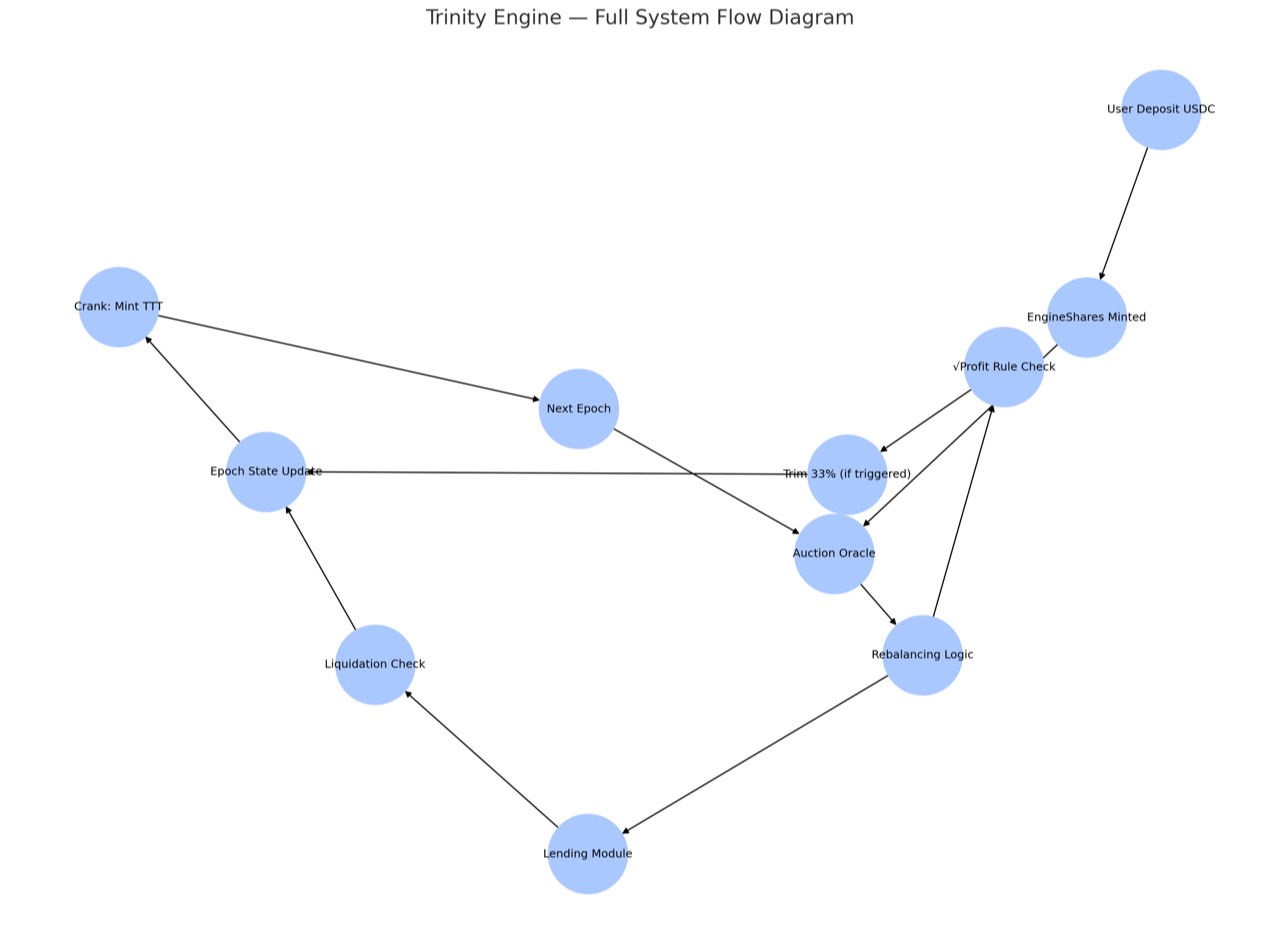
The manuscript links deposits, shares, profit checks, auctions, rebalancing, lending, liquidations, state updates, and crank rewards into one loop. That loop remains a design hypothesis until every transition has executable invariants and adversarial tests.
04 · Reserve doctrine
Conceptually unavailable for ordinary redemption or lending.
A proposed maximum allocation for independently collateralized loans.
Proposed USDC capacity above the protected bands.
These ratios are design targets—not proof of solvency. Gating redemptions may reduce forced selling, but cannot guarantee asset value, liquidity, stablecoin parity, or freedom from loss.
05 · Volatility battery
trigger when (V_now − V₀) / V₀ ≥ max(1 / √Q₀, 0.01)
then auction 33% of the position and establish a new baseline
Research requirement: define Q₀ on a dimensionless, versioned scale before this formula can govern capital. The manuscript’s 1% floor begins dominating at Q₀ ≥ 10,000 normalized units.
06 · Honest engineering boundary
Requires a live cranker market, durable incentives, bounded compute, and a tested no-crank recovery state.
An auction can produce prices, but lending safety still depends on adequate depth, resistance to self-dealing, and conservative pause rules.
Withdrawal gates can sequence redemptions; they cannot make volatile assets or USDC riskless.
Auctions still contain spread, market impact, adverse selection, failed settlement, and manipulation surfaces.
Immutability removes repair authority as well as rug authority. Deployment would require exceptional pre-launch verification and explicit migration assumptions.
07 · Where it meets Trade Wars
Nothing in Layer Zero gives an NFT, token, website, or strategy transaction authority. The connected wallet remains the only signer.
08 · Evidence path
Category definition
Layer Zero supplies the long-horizon economic imagination. Trinity Trading supplies the present-tense discipline: explicit wallet authority, manual PIT approval, versioned strategies, complete voyage accounting, and claims that never outrun evidence.