The card
Reading the public book.
This page does not sign. A swap still asks the wallet.
You or your agent. Launch now
Starter ship
Fighter Fly, mine, and trade. Veins forge the parts. A fight starts only when you attack or defend a world, and that fight moves the world's control by a fraction of a percent. Take the starterThe card
Reading the public book.
This page does not sign. A swap still asks the wallet.
Two public accounts decide the card. The house account is cvyVve76Yq77dDr6TdUudfrkR3Ez7YY7oTspK1gCokp. The price is the public mark. GET /api/onion repeats those numbers. It does not sign, and the laptop that prints them is not required. Anyone can recompute the card from the accounts.
On a profitable close of that newest layer: two thirds to the people in the stair, 10 percent set aside, and the rest stays and sizes the next card. A dip does not shrink the book. There is no stop, and no rate.
The founder still holds the upgrade key. The path is a multisig, then a frozen program. No date is set, so none is printed.
A script can read the same card. A script cannot spend. The wallet still signs. The API and SDK. Bring your agent. The flight, after that first battle, is for your agent.
TrinityTrading
The live story of Trinity capital—Long, Neutral, and Short—plus a private-to-you wallet check-in.
Trinity // Non-custodial command
Your wallet is the vessel. The blockchain is the saved state. Trinity turns verified public evidence into the fleet, risk, performance, and exact next action this wallet can support.
Connect wallet No account. No recovery words. Connecting never moves capital.System standby
The chain remembers.Current public status
The public record did not load. Nothing is being claimed.
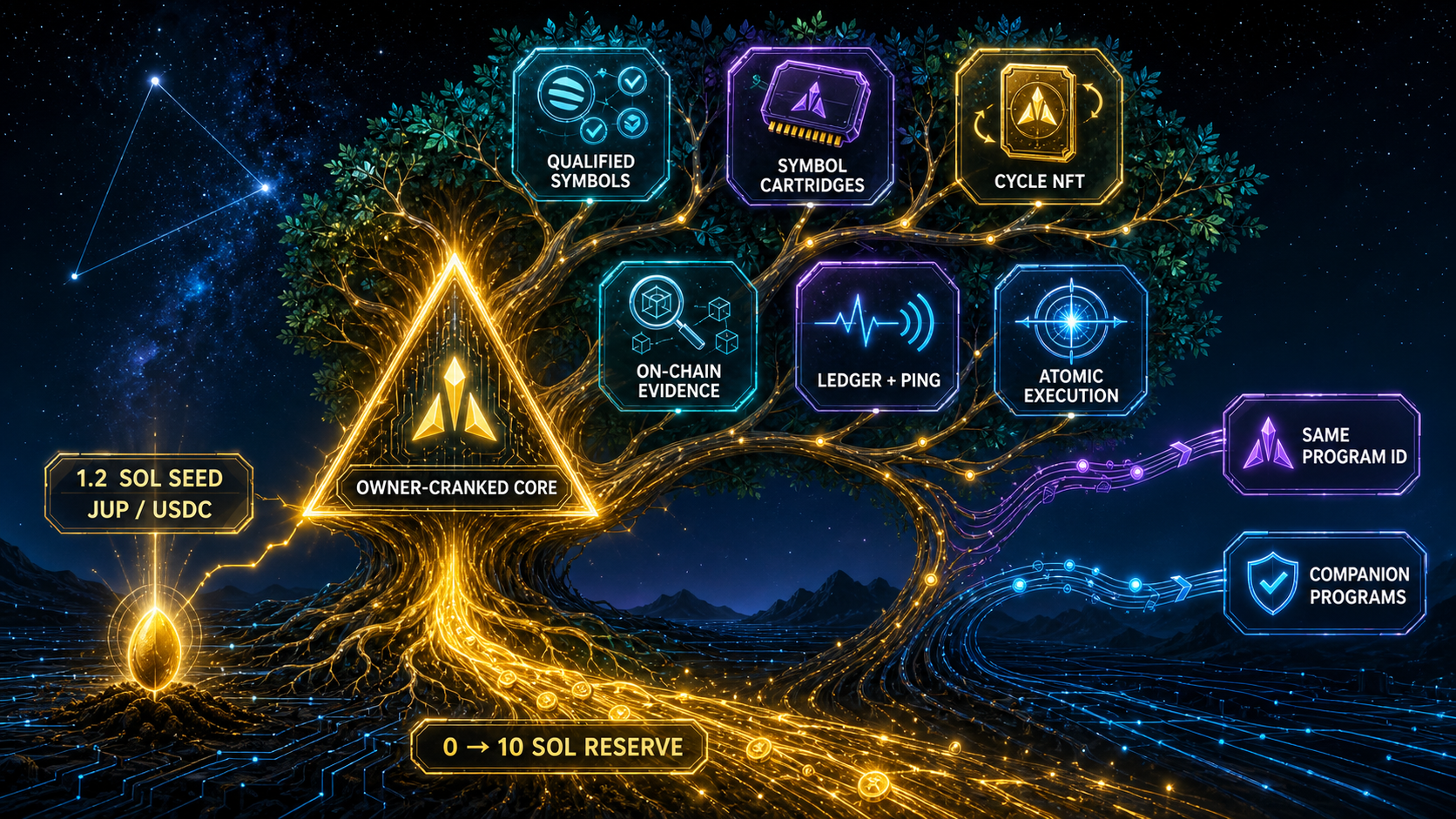
Trinity roadmap // Seed to operating forest
The live trade is the onion. A wallet says set me up and signs one step at a time: a hull, a house seat of 0.12 USDC, a JUP seat of 0.01, then one desk swap. The house is one shared JUP book, from 0.12 USDC up to 1.56 across 13 layers. A dip does not shrink that book. A profitable newest layer pays two thirds to the seats, 10 percent to the sun, and leaves the rest in the book. The JUP seat splits 57 staked, 33 held, and 10 in the till. The chat never holds the key. The older seed kernel, and its 100-lamport keeper crank, is a separate earlier gate.
The larger V14 design remains the security and behavior reference while the live Seed keeps custody, route, evidence, accounting, and upgrade authority inside its narrower launch boundary.
The house, the delegated onion, and the JUP pool are the programs a wallet signs. A sailor cranks only a listed card. An empty board sends nothing. A desk swap still asks the wallet. Inner rings are drawn beside this book. The live house still holds its stuck layers in one book.
The first buy is 0.12 USDC and does not wait for a dip. After that, the next buy waits until the mark is more than 1 percent under the average. A sell is the newest layer only, at 10 percent above that average. The sun is paid only on that profit. A dip stays open.
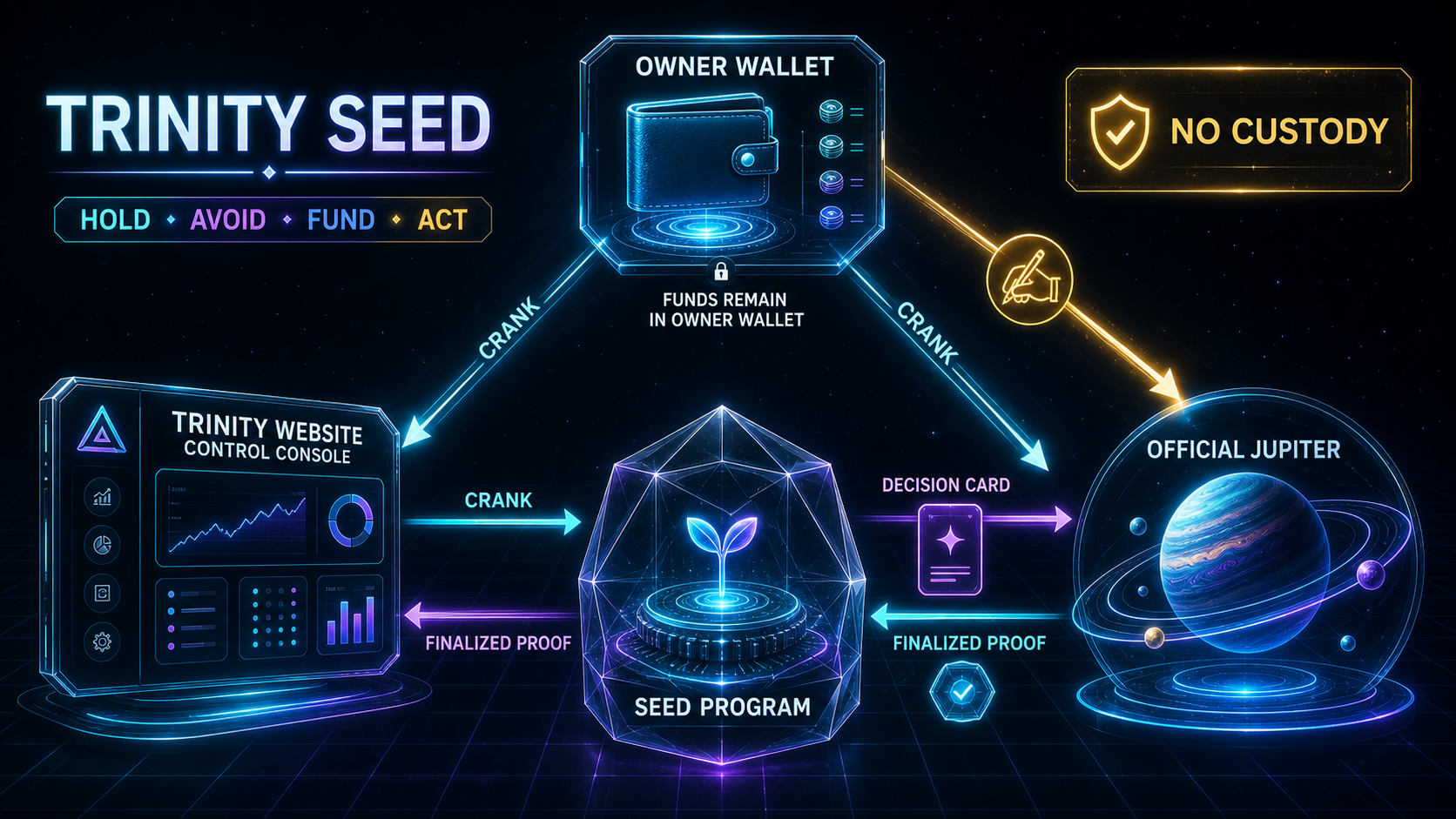
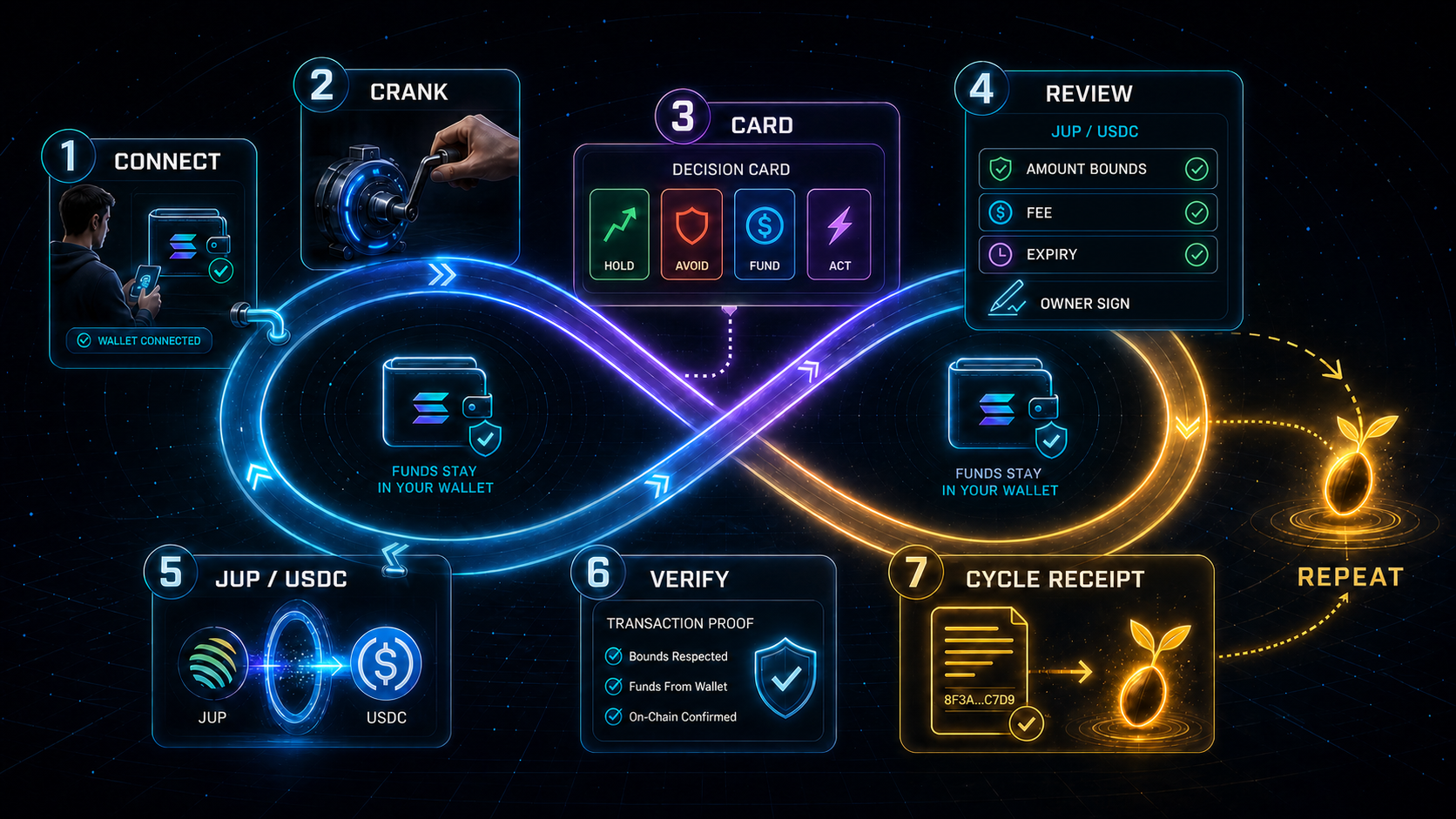
The seed records the intent but does not invoke an unverified route. The owner opens a fresh Jupiter quote, checks min-output, liquidity, slippage and capacity, reviews and signs the separate transaction, then returns its finalized evidence for strict reconciliation. Full exit, unchanged-balance cancel, and fail-closed recovery remain available. Automatic and Trinity-atomic trading remain off.
You publish each qualified Symbol Cartridge NFT. A user mints, holds, transfers, selects, or burns it without handling technical configuration. A finalized Cycle NFT records Cycle N and lets the owner initialize Cycle N+1 on the same qualified symbol. An arbitrary upload or correctly shaped file creates only a candidate—never execution authority.
The fixed Agent Zero Keeper wallet receives exactly 100 lamports from each successful Crank. The founder may also manually add classified trading profits or other founder funds. Trinity never skims a trade or pools wallet capital; the only automatic contribution is the disclosed 100-lamport Crank fee. The 10 SOL marker is a buildout goal, not a return promise.
Extend the same Program ID for compatible AssetConfigs, on-chain evidence, Ledger, Ping, Fleet identity, and rewards. A materially different route or risk model can live in a separately audited companion program. NFTs select approved modules; they never sign, qualify a market, or control capital.
Full destination // Ten independent growth rings
The seed launches only the smallest useful loop. Later capabilities can extend the same Program ID or attach through a separately qualified program without silently widening custody, signing, asset, route, or value authority.
One generic, wallet-aware rule engine for compact releases, qualified assets, Missions, cards, replay defense, receipts, exits, and sequential cycles.
Twelve-second evidence, source-exact indicators, simulation, journal, wallet view, crank preparation, card explanation, and exact signing handoff.
JUP/USDC is the only planned seed symbol. No current path is both source-closed, economically usable, and Trinity-atomic, so the seed uses a clearly separate manual Jupiter handoff and finalized reconciliation.
A human-friendly NFT points to an immutable qualified AssetConfig. Users handle a cartridge; the kernel verifies the underlying mint, strategy, evidence, route, version, and publisher commitment.
A completed cycle creates a deterministic receipt that can be represented as a collectible continuation token for the same qualified symbol and strategy release.
Only Trinity-created quantity and basis advance a Mission. Unrelated wallet inventory cannot inflate a stage, and every action has a terminal, reconstructable outcome.
A public 0-to-10-SOL goal may be funded manually from classified trading profits or founder funds. It is separate from every user's wallet and Mission.
Compatible state and instructions can be added through versioned upgrades and added rent while preserving one recognizable program identity.
Each new symbol receives its own canonical mint identities, token-extension policy, evidence source, route policy, strategy commitment, and independent release decision.
On-chain evidence commitments, shared inspection, notifications, Fleet identity, service records, and rewards can attach through independently gated modules.
Permanent boundary: a connected wallet, formatted candidate, NFT, royalty, notification, reserve deposit, or visible PIT Card never authorizes a trade. Every capital action still requires the exact active owner's approval. The seed remains upgradeable only through a separately approved cold or multisig loader authority; code readback detects drift but does not remove that centralized upgrade trust.
Cost boundary: 1.2 SOL is the complete peak seed deployment gate and 10 SOL is the later manual buildout goal. The exact seed quote is published only after the final ELF, state accounts, transaction fees, buffer, recovery, and rollback path are measured; an over-budget build remains undeployed.
Manual buildout reserve // Founder-controlled
This tracker is the older seed keeper: 100 lamports on a successful seed crank, plus founder deposits. The onion is separate. A sailor is paid 0.00001 SOL from fuel the owner already funded, and the sun is paid 10 percent of a profitable close. Trinity does not skim a desk swap, and a wallet’s balance is not reserve funding.
The public tracker begins at zero. Crank contributions count only after a finalized transaction is bound to the frozen Program ID and exact Crank instruction. Founder deposits appear only after independent classification. Unrelated Keeper-wallet balances and Mission funds are excluded.
The 100-lamport Crank contribution is a disclosed product-use fee, not an investment, donation, yield promise, performance guarantee, revenue share, or authorization for unattended trading.
Bridge · Public pulse
TrinityTrading.xyz is the running story of capital being managed across exchange books, Solana spot wallets, reserves, and Agent Zero. Visitors can watch the same rules confront live markets—and then check in their own wallet without handing over custody.
Current holdings, verified basis, realized history, and available capacity come before a trade idea.
Exit green first, manage bounded ladders second, rebuild reserve third, and open only qualified spot exposure.
Central accounts follow their own gates. A visitor's wallet receives a card and moves only after that owner approves it.
The public record loads here.
Tap an instrument.
Engine room · Actual P/L
These graphics are the scorecard for the trading story: closed profit, open movement, starting capital, and the combined line. They are reporting—not a promise, backtest, or substitute for risk.
Starboard · SolSpot ladder
SolSpot is long-only spot management. Trinity qualifies the market, opens a small starter, tracks verified basis, spaces every add farther apart, and exits only through a qualified green lane.
An asset needs exact mint identity, liquid routing, and durable activity before it can become a new entry.
The Small profile begins at 0.002 SOL. Larger profiles expand capacity, not conviction.
Each add must remain inside its wallet-specific cap. No basis, no managed add.
A qualifying profit exit takes priority over a new idea. Afterward, reserve and capacity can renew.
Center · Wallet-owned PIT
Paste a public Solana address or connect Solflare. Trinity reads the wallet, explains its Long / Neutral / Short shape, calculates verified add capacity, and shows one current trading card. A message can verify the wallet; a separate transaction is still required to trade.
Strategy Charters
Strategy Charter discovery is Pending.
The custom Trinity program is archived. Metaplex Core discovery, validation, and minting are not active until the NFT-only contract is qualified.
Can Trinity help?
This block does not sign. The swap is Onion. The battle is Fight the house.
Lower deck · Capacity
The 33 / 34 / 33 center is a capacity discipline, not a prediction. Long is volatile spot exposure. Neutral is recognized stable-value capital. Short is liquid USDC or supported cash-like value ready now.
SOL and non-stable spot exposure working for upside.
Recognized stable-value capital. No rate is promised.
Liquid USDC and supported stable value—the immediate add lane.
Nothing here is a rate. Only realized, verified capital can fund a new card. SOL held for fees or savings remains Long exposure even when it has an operational job.
Installed command deck
Install the PWA for a fast return to the Wheelhouse, remembered public fleet addresses, and device-bound Check-In continuity. Nothing monitors or trades in the background.
Bow · Market perspective
Market breadth and watchlists describe the weather around the wallets. They can slow entries or strengthen a wait decision, but they cannot erase wallet caps, invent basis, or authorize a trade.
Command deck / Trade Wars
The War Room organizes public Solana wallets into fleet roles, models bounded campaigns, and routes every real command through the existing wallet-bound PIT review.
Preparing the local fleet command ledger...
Diagnostics · Public evidence
Only delayed, redacted public evidence appears here. Operational details remain unavailable.
Signal mast · Agent Zero
Agent Zero is Trinity's tiny public test wallet: a visible account with its own P/L, reserve state, card history, and strict boundaries. Its neutral foundation is runway—not permission to increase risk.
Reserve funding supports continuity while every trade still lives inside Agent Zero's own tiny wallet and caps.
The point is to watch the system behave, not to make a small test account look invincible.
Its automation and its capital remain separate from visitor wallets and central exchange books.
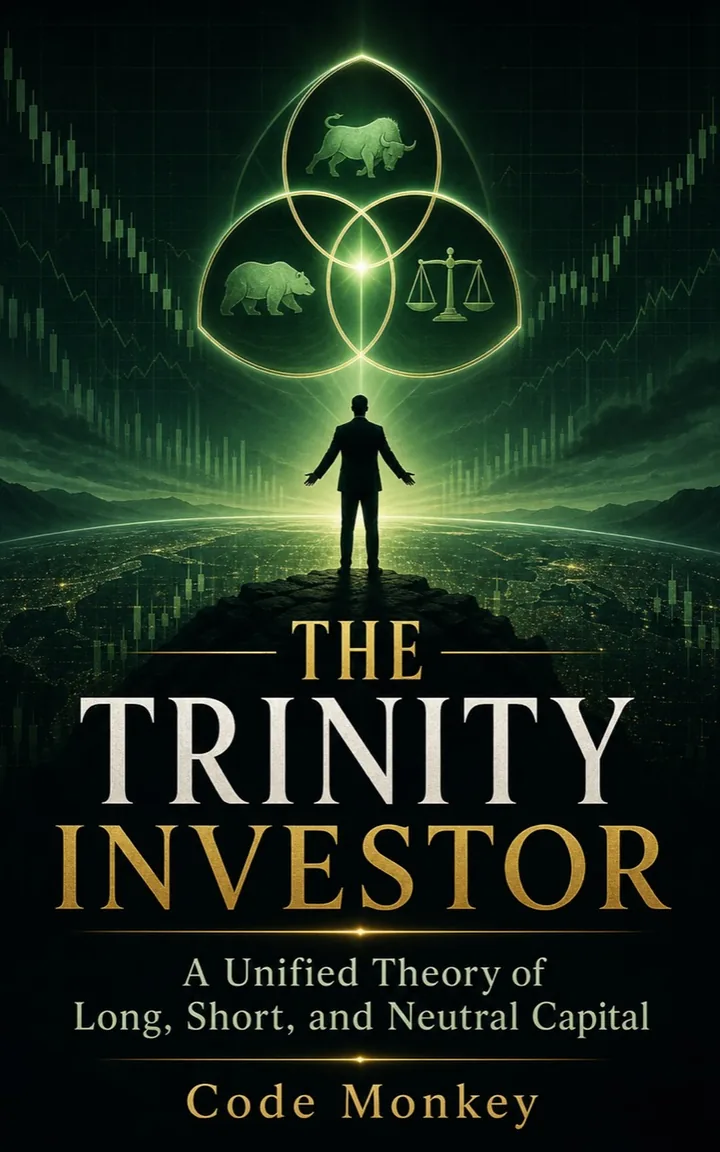
Captain's Library · The Trinity Investor
Enter a 34-film chapter archive, its opening film, and the complete 35-chapter map, then continue into the Trinity Universe or launch your own wallet-first captain experience.
The films are educational author commentary. Watching never connects a wallet or authorizes a transaction.